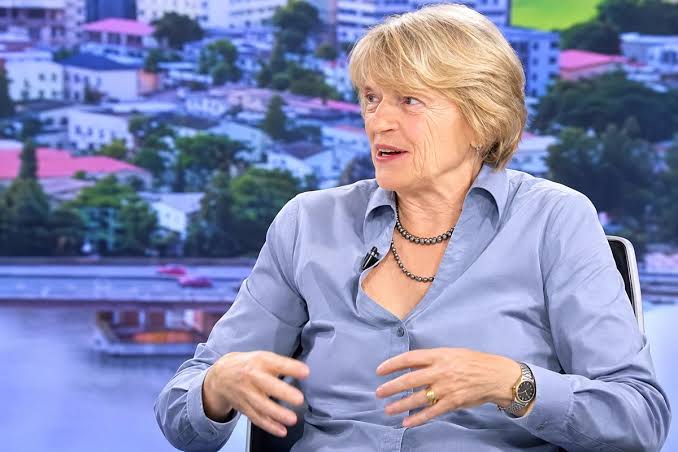
AMAA jury president Dorothy Wenner urges African filmmakers to reject Western imitation and build authentic stories rooted in their cultures
The President of the 2026 Africa Movie Academy Awards (AMAA) jury, Dorothy Wenner, has urged African filmmakers to abandon the imitation of Western cinema and develop original stories inspired by their cultures, experiences and creative perspectives.
Wenner said African filmmakers should resist the pressure to meet foreign expectations and instead build confidence in their ability to tell authentic stories that reflect the continent’s diverse identities.
She made the call during an interview with ARISE NEWS on Sunday, stressing that African cinema needed a distinct identity rather than reproducing Western styles and narratives.
“This is a new way of telling a story that is not a spoof of Western cinema, but it comes from storytelling from an African background and culture. So authenticity is something that you don’t create. It is something where, you know, you come to yourself. And it’s not an imitation,” she said.
The jury president also advised emerging filmmakers against copying previously successful productions, urging them to develop original ideas and explore what they personally want to communicate through their work.
“Don’t imitate the winner from last year. Very often happening. What I think is to really think, what have I to say? And what is my new way of telling my story, not imitating something that was successful earlier,” she stated.
She encouraged filmmakers to take creative risks, explore subjects that genuinely interest them and be willing to surprise audiences and award juries.
Wenner also raised concerns about the difficulties African films face in securing mainstream distribution in Europe, saying distributors often regard them as risky investments.
Speaking from her experience in Berlin, Germany, she said films from Africa struggled to gain access to regular distribution channels, regardless of whether they were documentaries, comedies or other genres.
“I’m from Berlin, Germany, and I can only say it’s so tough to have, to bring a film of African descent, no matter if it’s a documentary, if it’s comedy or whatever genre it is, into regular distribution,” she said.
According to her, distributors sometimes dismiss African productions as outdated or too risky to release, particularly amid uncertainty in the international film industry.
She said AMAA had an important role to play in creating opportunities for African cinema by developing strategies to promote its films and improve their visibility.
“So here is where I find AMAA is really at the fore of fighting for new revenues. And not with aggression, but with clever films and with clever strategies,” Wenner noted.
She further cautioned African filmmakers against shaping their productions around what they assume European audiences want to see about the continent.
Wenner described that approach as an outdated trap, arguing that filmmakers should prioritise their own perspectives rather than reproduce external expectations.
Assessing entries submitted for the 2026 awards, she described the quality of the films as exceptional, noting the emergence of new filmmakers and creative talents across different artistic departments.
She said the submissions were innovative and demonstrated a strong desire among filmmakers to communicate important ideas through cinema.
Among the productions that impressed her were Nigeria’s ‘The Herd’ and Kenya’s ‘One Woman, One Bra’.
Wenner said ‘The Herd’ surprised her because its storyline kept her uncertain about how the film would develop.
She described ‘One Woman, One Bra’ as a provocative satire and comedy that explored international aid and its effects on communities, praising the lead actress’s performance.
The jury president also called for fresh approaches to documentary filmmaking, pointing to the growing influence of mobile phones, which have made it easier for people to record and present their own experiences.
She said documentary filmmakers needed to adapt their storytelling techniques to this changing reality while maintaining the importance of observation and authenticity.
Wenner maintained that filmmakers should trust their instincts and draw from their own experiences when developing stories.
“I think we have to find our own voice. As creative people, that’s very important because oftentimes creative people are the lead, you know?” she said.
“So you find your own voice and you have confidence in yourself and confidence in your ability to tell that story. And know that what you are telling is based on truth. Not someone else’s truth, but your own truth.”
She also argued that filmmakers did not necessarily need large budgets to communicate meaningful ideas, urging them to make creative use of the resources available to them.
Her comments came shortly after the 22nd edition of the Africa Movie Academy Awards, held on Sunday, November 15, 2026, at the Marriott Hotel in Ikeja, Lagos State.
At the ceremony, Nigerian actors Wale Ojo and Linda Ejiofor were among the major winners, while Kenya’s ‘One Woman, One Bra’ won Best Film.