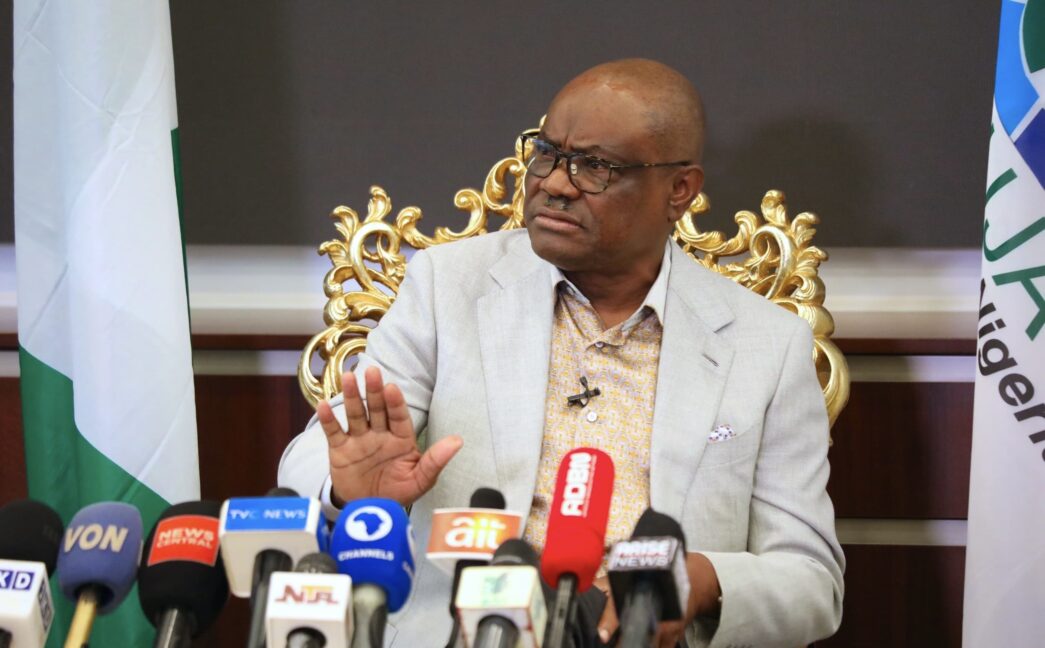
As Nigeria moves closer to the 2027 general election, one political figure continues to redefine the boundaries of party loyalty and political influence: Nyesom Wike. From leading the G5 governors’ revolt within the Peoples Democratic Party (PDP) to championing a proposed Rainbow Coalition in support of President Bola Tinubu, Wike’s politics has consistently revolved around one objective—remaining influential regardless of party lines.
His latest disagreement with governors elected on the platform of the All Progressives Congress (APC) is therefore more than an ordinary political quarrel. It reflects a deeper contest over who controls the political machinery surrounding the president and how loyalty should be organised ahead of a presidential election.
The APC Governors’ Forum recently rejected any political arrangement capable of creating parallel campaign structures outside the party. The governors insisted that support for President Tinubu should flow through the APC and its candidates at every level.
Wike responded by dismissing claims that he sought an alliance with the governors. According to him, the proposed Rainbow Coalition is not an alternative political party but a broader network of politicians from different platforms united behind Tinubu’s re-election.
That distinction lies at the heart of the controversy. Wike argues that a politician can remain a member of one party while supporting another party’s presidential candidate without abandoning participation in governorship, National Assembly or state assembly elections through his own platform.
For the APC governors, however, presidential and legislative elections are inseparable. Their concern is that mobilising support for Tinubu outside the formal APC structure could weaken the party’s candidates in other contests.
To understand the Rainbow Coalition, it is necessary to revisit the events of 2022.
Wike emerged as one of five PDP governors who formed the G5, also known as the Integrity Group, after former Vice President Atiku Abubakar secured the PDP presidential ticket. The governors demanded internal reforms, including the resignation of then National Chairman Iyorchia Ayu, and eventually withheld support from Atiku’s campaign.
The G5 demonstrated that party membership did not automatically determine presidential loyalty. Its members remained PDP governors while adopting different positions during the presidential election.
The Rainbow Coalition appears to extend that philosophy beyond the PDP. Rather than resisting a party from within, Wike is attempting to build a cross-party political network around an incumbent president while allowing participants to retain their separate political identities.
The disagreement is less about Tinubu and more about political structure.
State governors possess institutional authority through their control of party organisations and government machinery within their states. Wike, by contrast, relies on personal political networks developed over decades in Rivers State and reinforced by his current position as Minister of the Federal Capital Territory.
His argument is provocative: political influence does not necessarily belong to whoever controls party structures, but to whoever can mobilise voters.
That proposition challenges the traditional hierarchy of party politics. If a minister can independently organise electoral support for a president outside the APC, the governors inevitably lose part of their leverage.
No state illustrates Wike’s influence better than Rivers.
His prolonged political conflict with Governor Siminalayi Fubara eventually escalated into a constitutional crisis that prompted President Tinubu’s declaration of a state of emergency in Rivers in March 2025.
Whether viewed as political intervention or constitutional necessity, the episode demonstrated the extraordinary significance of Wike’s political structure within Rivers.
Now, by publicly declaring his intention to deliver both Rivers State and the FCT for Tinubu in 2027, Wike has reopened questions about who truly commands the electoral machinery in those territories—the APC or his own political network.
President Tinubu occupies a delicate position.
On one hand, Wike offers access to political constituencies beyond the APC. On the other, the APC governors remain indispensable because they control the governing party’s formal structures across the states.
The president therefore has every incentive to prevent the disagreement from becoming a permanent rupture. Rather than choosing between Wike and the governors, his challenge may be finding a way to make both politically useful without allowing competing structures to undermine one another.
The Rainbow Coalition also raises broader questions about the nature of Nigerian democracy.
Can a politician remain in the PDP while openly campaigning for an APC president? Constitutionally, the answer is largely political rather than legal. Elections for president, governor and legislature are separate contests, and voters are free to split their ballots among different parties.
The difficulty lies in party discipline. To APC leaders, supporting Tinubu should naturally include supporting APC candidates across the ballot. To Wike, presidential loyalty is a personal political choice that does not require abandoning his party’s legislative ambitions.
The journey from G5 to Rainbow Coalition reflects an evolution rather than a contradiction.
The G5 was an internal resistance movement designed to reshape the PDP’s presidential direction. The Rainbow Coalition seeks to mobilise support beyond party boundaries while preserving the independence of participating politicians.
Whether the coalition becomes a durable political force will depend on organisation, personalities, candidate selection and the willingness of the APC leadership to accommodate an influential ally operating outside its formal campaign structure.
For now, the disagreement has revealed a fundamental question that could define the 2027 election: Does political loyalty belong primarily to the party, the presidential candidate, or the individual politician?
The answer may ultimately determine not only Wike’s political future, but also the evolving architecture of power around President Tinubu as Nigeria heads into another defining electoral cycle.